
Magnetic vs Pin Name Badges: Which Is Better for Staff and Events?
The front of a name badge gets most of the attention, but the backing often decides whether staff actually like wearing it. Magnetic badges protect clothing from pin holes and are quick to position, while pin or clip fasteners can be more practical on thick workwear, aprons or environments where magnets are not appropriate. This guide compares the options before you order.
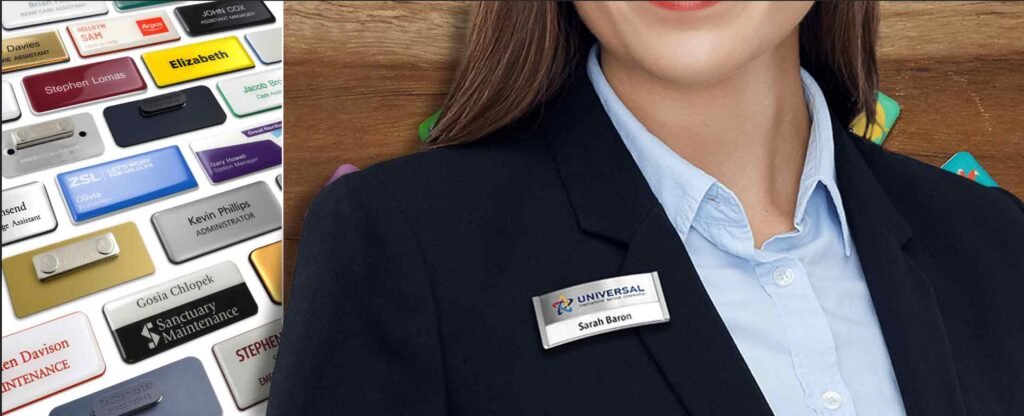
Choose magnetic name badges when staff wear shirts, blouses, suits or uniforms where repeated pin holes are undesirable. Choose pin or clip backings when the garment is very thick, the badge must stay fixed during active work, or the workplace has restrictions on magnetic attachments. Neither backing is automatically best for every team.
How magnetic name badges work
A magnetic name badge uses a two-part fastening system. The badge sits on the outside of the garment, while a magnetic or metal backing piece sits behind the fabric. The two parts hold the material between them without piercing it.
This is the main reason magnetic name tags are popular for customer-facing uniforms and business clothing: there is no pin passing through the shirt, blouse or jacket.
How pin and clip name badges differ
Pin-backed badges use a sharp pin and clasp that passes through the garment. Clip backings attach to an edge such as a pocket, collar or lapel without necessarily piercing the fabric.
Pin backings are simple and secure, especially on heavier work clothing. Clips are useful where the uniform already provides a suitable edge or pocket. The best choice depends on the garment rather than the badge design alone.
Magnetic vs pin name badges: quick comparison
| Factor | Magnetic backing | Pin backing |
|---|---|---|
| Pin holes in clothing | No | Yes |
| Fast to attach / reposition | Very easy | Simple, but takes more care |
| Thin shirts / blouses | Usually well suited | Works, but pierces fabric |
| Heavy aprons / thick uniforms | May need testing | Often more practical |
| Visible fastening hardware | Hidden behind garment | Pin is behind garment |
| Frequent removal | Convenient | Less convenient |
| Magnet-restricted environment | May be unsuitable | Better choice |
| Typical cost | Usually higher | Usually lower |
Which backing is better for uniforms and clothing?
If staff wear lightweight corporate uniforms, shirts, blouses or tailored clothing, magnetic name badges have a clear practical advantage: they do not create repeated pin holes.
On thick aprons, padded jackets, heavy vests or layered workwear, however, magnetic hold can vary. A pin or clip can be the more dependable option because it does not rely on magnetic force through several layers of fabric.
Choose the backing after checking the actual uniform. If staff wear more than one uniform type, it can be better to test the badge on each garment before placing a large order.
Comfort and everyday use
A badge may be worn for eight or more hours, so ease of placement matters. Magnetic backings are quick to move and reposition, which is useful when staff change shirts, jackets or shifts frequently.
Pin backings are familiar and remain a sensible option for staff who attach the badge once and leave it in place for the full shift. Clip backings are useful when employees have a pocket or collar position that gives the clip a stable grip.
Which industries commonly use magnetic name badges?
Useful for reception, concierge, restaurant and guest-facing teams wearing coordinated uniforms.
Easy staff identification while protecting branded shirts from repeated pinning.
Suitable for reception teams, client-facing staff and events.
Provides visible staff names without piercing lightweight uniforms.
Useful for organizers, exhibitors and customer-facing teams where a reusable badge is required.
Can work for staff identification, though attachment choice should follow the school’s uniform and safety policy.
Are magnetic name badges good for events?
Magnetic badges work best at events when the same team members will wear a reusable, branded badge across multiple days or multiple events. They are especially useful for exhibitors, hosts, organizers and sales staff wearing business clothing.
For very large conferences where hundreds or thousands of temporary attendees need identification, disposable inserts, lanyards or card holders may be more practical than individually manufactured magnetic badges. The type of attendee matters.
What should go on a staff name badge?
A name badge has limited space, so the hierarchy should stay simple. The wearer’s name should normally be the easiest element to read.
Avoid shrinking names to make room for long slogans, phone numbers, websites or multiple service descriptions. A staff badge is primarily an identification tool.
Plastic, acrylic or metal name badges?
The backing is only one part of the decision. The front material changes weight, durability and appearance.
| Material | Good for | Consider |
|---|---|---|
| Printed plastic | Retail, events, general staff use | Lightweight and practical |
| Acrylic | Modern retail, clinics, offices, creative brands | Can provide a clean contemporary appearance |
| Metal / metal-look | Hotels, premium retail, corporate environments | Heavier badge may require an appropriate backing |
| Reusable insert badge | High staff turnover, temporary staff, trainees | Names can be changed without remaking the full badge |
When magnetic backings may not be suitable
Some workplaces, equipment areas or personal medical-device situations may have restrictions around magnets. If your team works around magnet-sensitive equipment or an employee uses an implanted medical device, follow the relevant workplace and device-manufacturer guidance rather than assuming a magnetic attachment is appropriate.
In those cases, a pin, clip, lanyard or another non-magnetic attachment may be the better option.
How to choose the right badge backing for your team
| If your priority is… | Start with… |
|---|---|
| Avoiding holes in shirts or blouses | Magnetic |
| Fast daily attachment and removal | Magnetic |
| Heavy apron, jacket or thick workwear | Pin or clip |
| Lowest-cost attachment | Pin |
| Pocket or collar already available | Clip |
| Magnet-restricted environment | Pin, clip or lanyard |
| Temporary attendee identification | Lanyard / insert system may be better |
Common mistakes when ordering employee name badges
- Choosing the badge before checking the uniform. Attachment suitability depends heavily on fabric and garment design.
- Making the employee name too small. Identification should remain the primary purpose.
- Using a long job title. Shorten the title where possible.
- Ordering one backing for every department. Warehouse staff and reception staff may need different attachments.
- Ignoring badge weight. Larger metal or acrylic badges can need a stronger backing.
- No spare badges. Consider replacements for new staff, lost badges and name changes.
- No roster check. Confirm spelling, capitalization and job titles before production.
What to prepare before requesting a name badge quote
- Quantity — total badges plus any spares.
- Employee names — preferably supplied in a clean spreadsheet or list.
- Job titles — where required.
- Logo / brand artwork — preferably vector artwork.
- Badge size — or the information that needs to fit.
- Material — plastic, acrylic, metal-look or another option.
- Backing — magnet, pin, clip or mixed requirements.
- Deadline — especially for events, openings and new staff onboarding.
Not sure whether magnet, pin or clip is right?
Send J Designo a photo or description of the uniform and tell us how the badge will be used.