
Office Glass Privacy & Frosting
Frosted Glass for Office Privacy: How Much Coverage Does Your Workspace Need?
Clear glass keeps an office bright and open, but meeting rooms, executive offices and internal partitions often need more visual privacy. Frosted glass film can screen direct views without turning the space into a solid wall. The key decision is not simply whether to use frosting—it is how much of the glass to cover, at what height, and whether the design should be plain, patterned or branded.
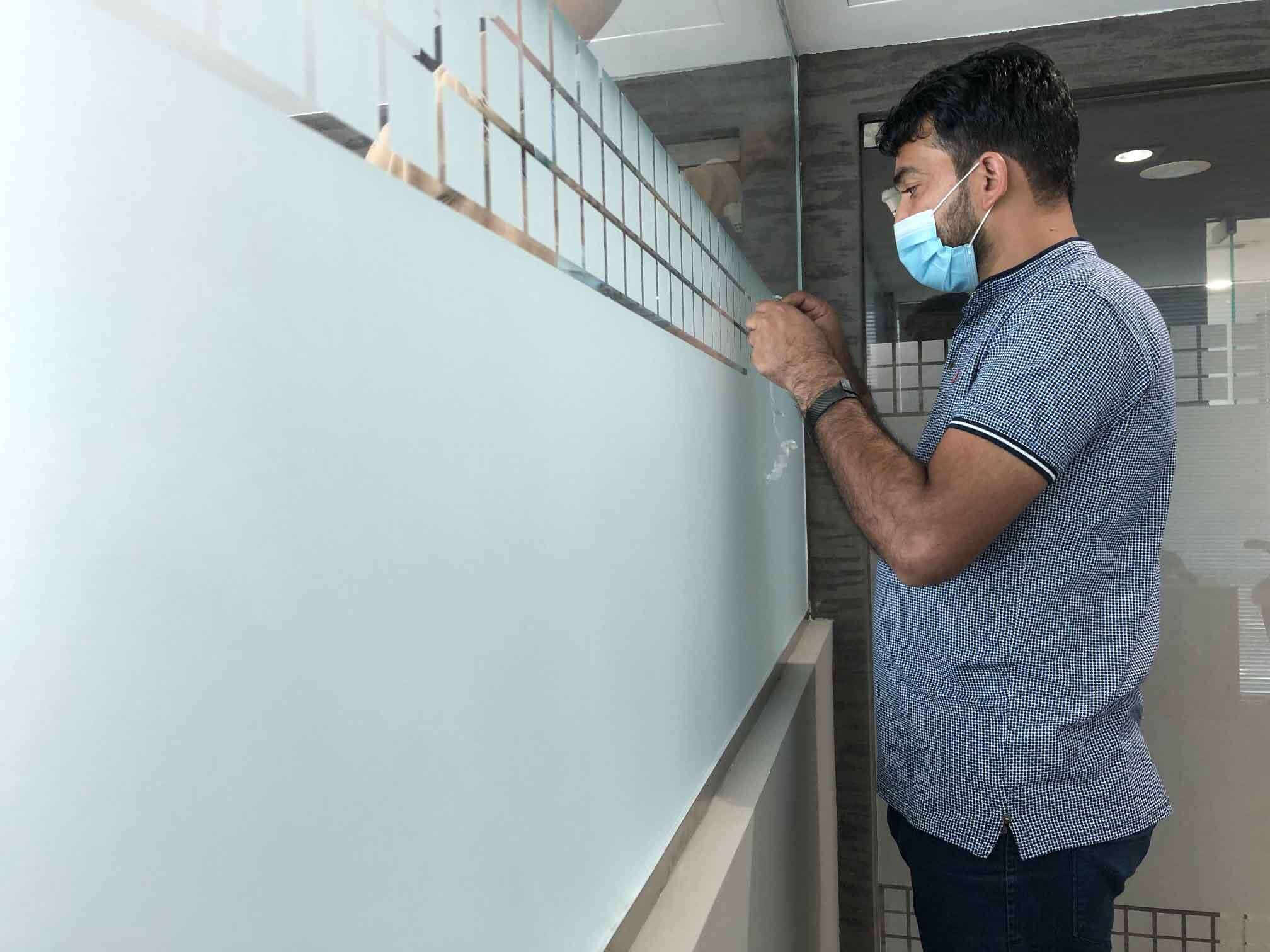
Use full frosting where stronger visual screening is the priority. Use a privacy band or partial frosting when you want to block seated and standing sightlines while keeping more of the glass visually open. Branded frosting works well when privacy and office identity need to share the same surface.
What frosted glass film actually does
Frosted film is a translucent material applied directly to existing glass. It diffuses the view through the panel and creates an etched-glass appearance while still allowing daylight to pass through.
It is commonly used on office partitions, meeting-room glass, doors, reception areas and internal windows where completely clear glass creates too much direct visibility.
Frosting provides visual screening, but it should not automatically be described as complete concealment. Silhouettes, movement and light can still be visible depending on the film, lighting conditions and distance from the glass.
Where office glass usually needs privacy
Useful where presentations, discussions or client meetings should not be directly visible from corridors.
Reduces direct sightlines while maintaining the open feel of glazed partitions.
Helps screen sensitive conversations from surrounding work areas.
Can separate workspaces behind reception without replacing existing glass.
Useful where visual screening is required on internal glass.
Can improve visibility of the door itself while also adding branding or privacy.
Full, partial or banded frosting?
| Coverage | Best for | What it does |
|---|---|---|
| Full-height frosting | Meeting rooms, consultation spaces, stronger privacy needs | Screens the majority of direct views through the panel |
| Mid-height privacy band | Open offices, corridors, glass partitions | Blocks common seated/standing sightlines while leaving more clear glass |
| Lower-panel frosting | Desk-level privacy | Screens lower activity while keeping the upper glass open |
| Gradient frosting | Modern office interiors | Moves gradually from frosted to clear for a softer transition |
| Patterned frosting | Decorative privacy | Combines screening with a repeated design |
| Branded / logo-cut frosting | Reception, boardrooms, branded office glass | Adds identity while retaining functional screening |
Plan the frosting around real sightlines
A common mistake is choosing a decorative height without checking what people can actually see through the glass. Privacy should be planned around how the room is used.
Mark the proposed frosting height temporarily on the glass and walk the corridor before approving production. A simple site check can reveal privacy gaps that are difficult to judge from artwork alone.
Can frosted film provide privacy without making the office dark?
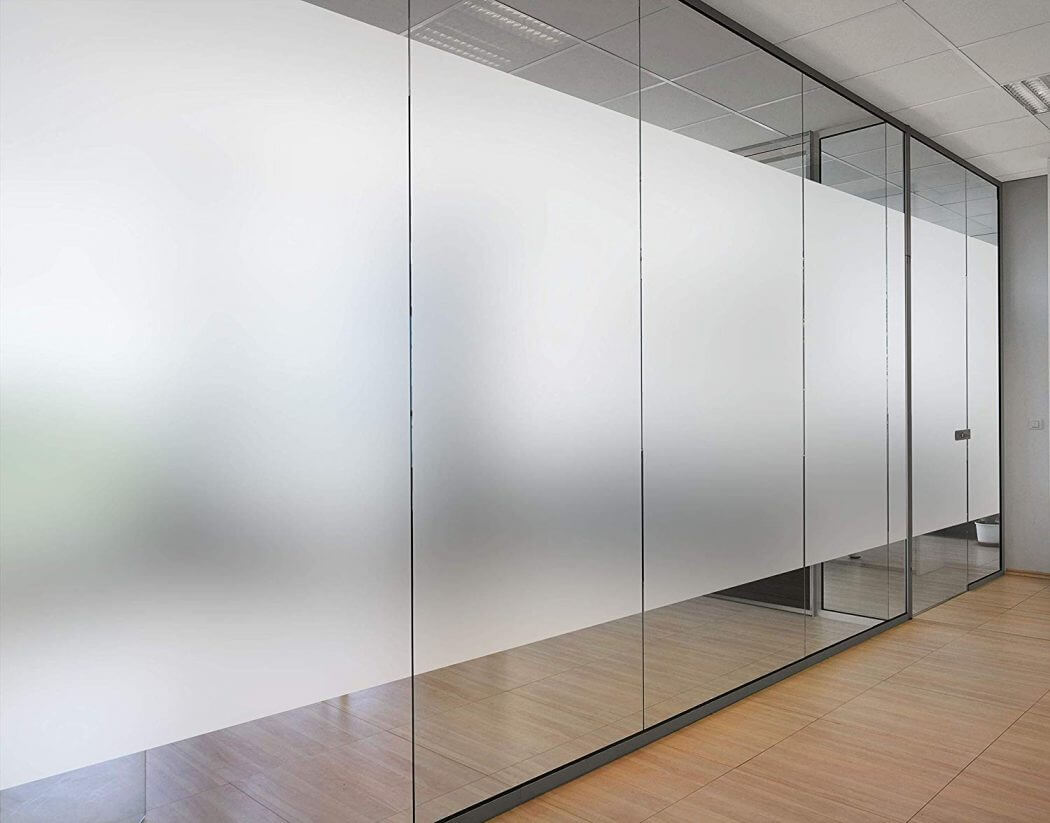
One of the main reasons offices use frosted film is that it can diffuse direct visibility while still transmitting daylight. This helps preserve the bright character of a glass-partitioned workspace better than replacing the panel with a solid wall or opaque board.
The exact amount of light and visual screening depends on the film type and coverage. Full frosting will create a different result from a narrow privacy band or gradient design.
How to combine privacy with office branding
Frosting does not have to be a plain rectangle. Logos, clear cut-outs, repeated patterns, lines and geometric shapes can integrate the glass into the office identity.
The surrounding panel is frosted while the logo remains transparent.
The logo itself is applied as frost while the surrounding glass remains clear.
Useful when a subtle brand motif needs to continue across multiple partitions.
Simple horizontal bands can create screening without visually closing the entire panel.
Branding should not compromise the privacy requirement. If a large clear logo creates a direct viewing gap into a meeting room, the artwork needs to be adjusted rather than treating the logo as purely decorative.
Different rooms need different levels of frosting
| Office area | Typical approach |
|---|---|
| General open-office partition | Mid-height band or patterned privacy zone |
| Meeting room | Broader band, gradient or near-full coverage depending on use |
| Boardroom | Stronger screening with controlled branding |
| Executive office | Privacy band or gradient depending on desired openness |
| Reception glass | Brand-led design with selective privacy |
| Internal glass door | Coordinated band / logo with visibility marking |
Why frosting can suit rented offices and changing fit-outs
Applied film is useful when an office layout or branding may change later. It can usually be removed and replaced more easily than permanently altering the glass itself.
This is particularly relevant for leased offices, expanding teams, rebrands and fit-outs where the glass partitions may remain but room functions change.
If permanent architectural glass is being considered instead, the separate frosted glass film vs etched glass guide explains that decision in more detail.
What affects the quality of a frosted glass installation?
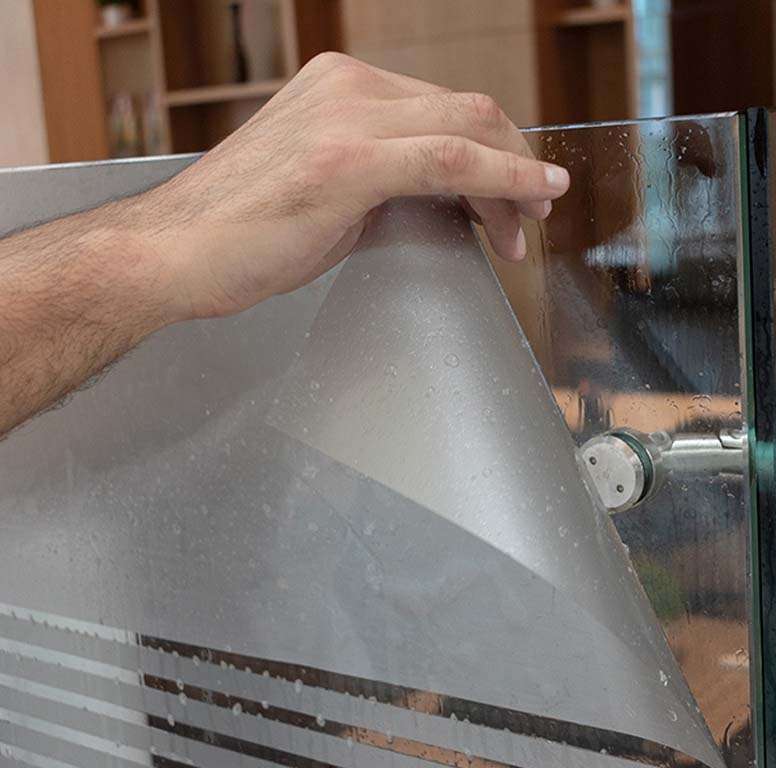
Surface preparation matters because dirt, grease and trapped debris can affect adhesion and finish. For commercial office work, accurate measurement, consistent alignment across multiple glass panels and clean trimming around frames and door hardware are equally important.
How to measure office glass before requesting a quote
For a preliminary quotation, measure the visible glass area rather than the complete frame. If the office has several panels, record each width and height separately because partition systems are not always perfectly uniform.
- Count the number of glass panels and doors.
- Measure the visible width of each panel.
- Measure the visible height.
- Note whether you want full, partial or banded coverage.
- Take wide photographs showing the complete partition.
- Take close photos of handles, frames or unusual edges.
- Send the logo or pattern artwork if branding is required.
Common office frosting mistakes to avoid
- Calling every frosted film “complete privacy”. Actual screening depends on coverage, material, lighting and distance.
- Choosing the frosting height without checking sightlines.
- Creating large clear logo areas in rooms that need strong privacy.
- Ignoring door alignment. Bands that jump in height across adjacent panels look unfinished.
- Using decorative patterns that are too open for the privacy requirement.
- Measuring one panel and assuming all partitions are identical.
- Finalizing artwork before checking the actual office layout.
- Forgetting future changes. Consider whether rooms, branding or tenant requirements may change later.
What to send before requesting an office frosting quote
Not sure how much of the glass should be frosted?
Send J Designo photos of the partitions and explain which rooms need privacy. We can discuss whether full, banded or branded frosting fits the space.
Frequently asked questions about office glass frosting
Need help choosing the right specification?
Send the product or service, quantity, artwork status and deadline. For signage or installation work, include approximate dimensions and site photos where possible.