
Roll-Up Banners for Events in Dubai: Size, Design & Setup Guide
Roll-up banners work well at exhibitions, conferences, product launches, receptions and retail activations because they are compact, portable and quick to set up. But the result depends on choosing the right size, keeping the design readable from a distance and placing the banner where people can actually see it.
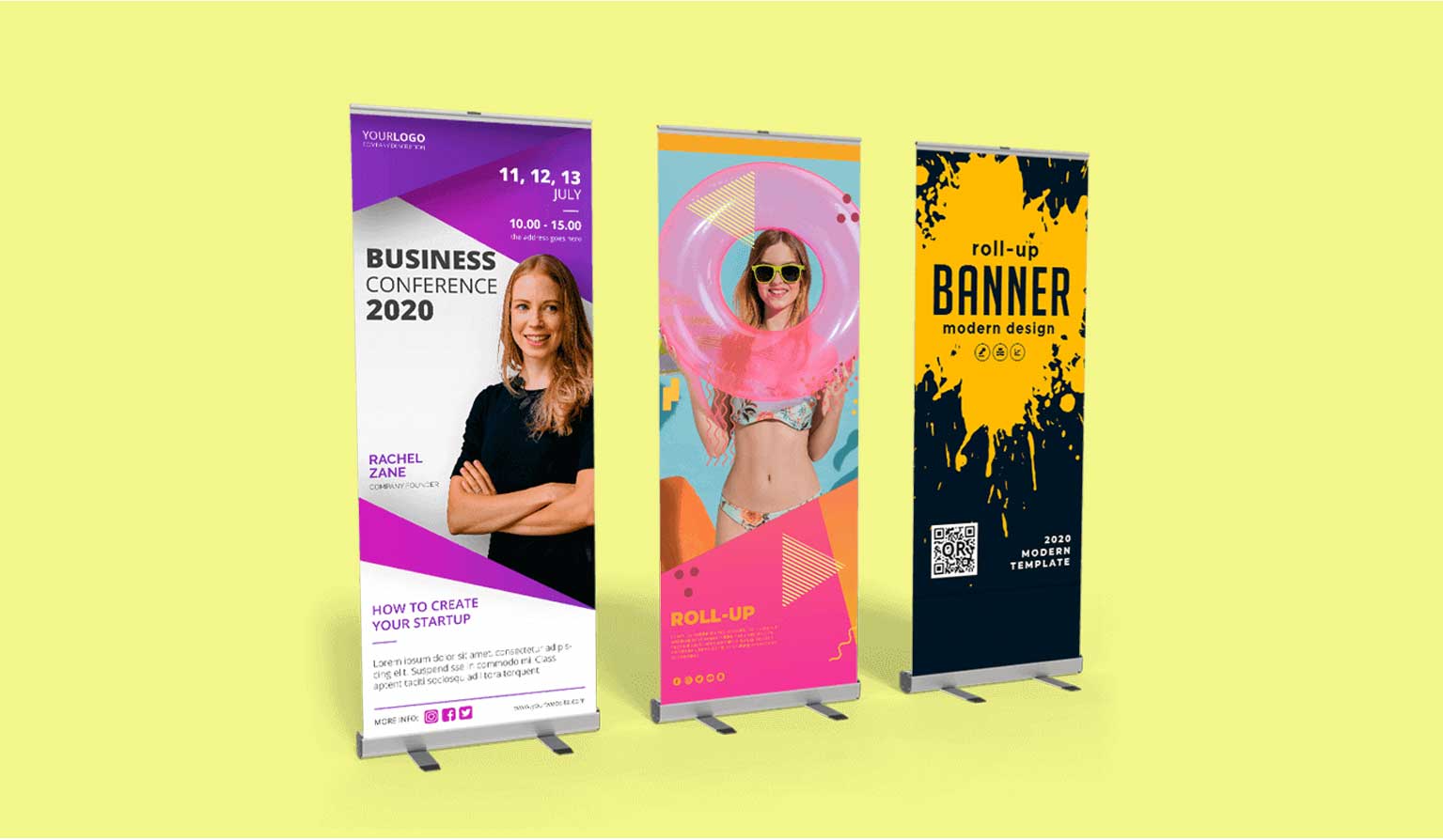
Use a roll-up banner when you need a freestanding branded display that one person can transport, set up quickly and reuse. For most exhibition booths and indoor business events, the common 85 × 200 cm format is a practical starting point; wider formats make sense when the banner needs more visual presence or must be read from farther away.
What is a roll-up banner?
A roll-up banner — also called a pull-up banner or retractable banner stand — combines a printed graphic with a spring-loaded base. The graphic rolls into the base for transport and is pulled upward onto a support pole when in use.
That makes it different from a simple hanging banner or rigid display board. It does not normally need a wall, permanent fixing or a complicated frame, which is why roll-up displays are widely used for temporary business events and exhibition stands.
Why roll-up banners work well for events and exhibitions
The stand packs into a compact format and can usually be carried by one person.
No wall mounting is required for normal indoor use, making setup practical for temporary events.
Evergreen company branding can be used across multiple events if the message remains relevant.
Useful beside registration desks, booth corners, entrances and product displays.
A vertical format gives useful display area without taking the floor space of a full backdrop.
Two or more banners can frame a booth, presentation area or reception point.
What roll-up banner size should you choose?
Current Dubai printing results consistently show 85 × 200 cm as the most common standard format, with wider 100, 120 and 150 cm options used when more visual area is needed. The exact sizes available depend on the stand system, so confirm the hardware before designing the artwork.
| Typical size | Best suited to | Design approach |
|---|---|---|
| 60 × 160 cm | Tight spaces, counters, smaller displays | Very short message, minimal content |
| 85 × 200 cm | Exhibition booths, receptions, events | Strong headline, one main visual, one CTA |
| 100 × 200 cm | Wider product visuals or bilingual layouts | More horizontal breathing room |
| 120 × 200 cm | Busy halls and higher-visibility positions | Stronger visual presence |
| 150 × 200 cm+ | Feature stands, launches, larger activations | Treat more like a compact backdrop |
Choose size based on viewing distance and available booth space, not simply because a wider banner looks more impressive in a catalogue.
How to design a roll-up banner people can read quickly
Exhibition visitors do not study banners like brochures. They usually see the display while walking, talking or looking across a busy stand. The design should work in layers: first the brand and headline, then the supporting message, then the action.
A practical content hierarchy
- Logo / brand — recognizable without dominating the entire layout.
- Main headline — a short reason to look closer.
- Product or service visual — one strong image is often better than several small ones.
- Supporting message — keep it brief.
- Call to action — website, QR code, booth instruction or contact route.
Keep the most important message in the upper half. The bottom area is more likely to be blocked by people, furniture or the stand base.
Design for viewing distance, not close-up inspection
A banner that looks attractive at arm’s length may fail across an exhibition aisle. Headline size, contrast and image simplicity matter more as the viewing distance increases.
If the roll-up banner will sit beside a reception desk, people can read smaller supporting text. If it needs to attract attention across a busy trade show floor, reduce the amount of copy and make the main message much larger.
Where should you place roll-up banners at an event?
Useful for the main brand message or offer visitors should see before entering.
Works for event branding, schedules, instructions or sponsor recognition.
Use one banner to explain a product category or key benefit without crowding the display.
Can reinforce branding where a full stage backdrop is unnecessary.
Useful for wayfinding, session identification or sponsor branding.
Good for launches, temporary offers and mall campaigns when the display is sheltered indoors.
One banner or several?
More banners do not automatically create a stronger stand. In a small booth, too many vertical displays can make the space feel crowded and repeat the same information.
A useful approach is to give each banner one job: one for the brand, one for a product or offer, and one for a specific action if the booth is large enough. If two banners sit together, design them as a pair rather than duplicating the same artwork.
What material should the printed graphic use?
Roll-up graphics can be produced on different banner and synthetic media depending on the stand, finish and intended use. For indoor exhibitions, the main considerations are print quality, opacity, glare, flatness and how often the banner will be transported.
A more matte surface can be useful under strong exhibition lighting because it reduces reflections. Whatever material is selected, it should be compatible with the exact retractable stand mechanism.
Are roll-up banners suitable for outdoor use in Dubai?
Standard roll-up banners are primarily indoor display products. Wind can make the tall, narrow stand unstable, while heat, dust and direct sun can increase wear. If the event is outside, tell the printer and event organizer before assuming a normal indoor roll-up is suitable.
For sheltered entrances or very short outdoor use, a heavier-duty system may sometimes be appropriate, but outdoor conditions should be assessed separately from normal exhibition use.
How should roll-up banner artwork be prepared?
The artwork should be created from the printer’s template for the exact stand. Different systems may require additional image area that disappears into the base or top rail, so designing only to the visible size can create production problems.
How to make a roll-up banner reusable across several events
If you attend exhibitions regularly, avoid putting short-lived dates or one-event-only details on every banner. Keep at least one display focused on evergreen branding, core services or a permanent value proposition.
Event-specific pricing, dates or promotions can go on a second banner, a smaller sign or a replaceable display. This reduces the chance that the entire roll-up becomes unusable after one campaign.
Common roll-up banner mistakes at exhibitions
- Too much text. A banner is not a brochure.
- Headline too low. Keep the primary message in the upper viewing area.
- Low-resolution images. Large-format printing makes poor image quality obvious.
- Weak contrast. Exhibition lighting can make subtle colour combinations difficult to read.
- Using several tiny images. One clear visual usually works better from a distance.
- Wrong size for the booth. Measure the actual space before ordering.
- No clear action. Tell visitors what to do next.
- Designing without the stand template. Important content can disappear into the cassette area.
What to confirm before ordering a roll-up banner in Dubai
- Banner size — based on booth size and viewing distance.
- Quantity — one display or a coordinated set.
- Event date — allow time for proofing and production.
- Indoor or outdoor use — this affects the display system.
- Artwork status — finished file or design support required.
- Stand included? — confirm whether the quote includes the base, pole and carry bag.
- Graphic replacement — ask whether the stand can be reused with a replacement print.
- Venue requirements — check exhibition-organizer rules where relevant.
Preparing for an exhibition or event?
Send J Designo your event date, booth dimensions and the message you want visitors to see.